Categories
How Fake Form I-9 Documents Are Redefining American Employment in 2026
Walk into any construction site in Texas, restaurant kitchen in Florida, or agricultural field in California today, and you’re witnessing a quiet revolution in American employment. Beneath the surface of our formal economy operates a shadow workforce, empowered by increasingly sophisticated Fake Form I-9 documents that are fundamentally reshaping how businesses operate and how millions participate in the labor market. This isn’t some fringe phenomenon—it’s become a mainstream adaptation to economic realities that our immigration and employment systems have failed to address. The numbers are staggering, the implications profound, and the technological innovations driving this transformation would have seemed like science fiction just a few years ago.
The New Reality: Fake Documents as Economic Catalyst
The landscape of fake documentation has undergone a radical transformation. What was once a crude cottage industry has evolved into a sophisticated technological enterprise. According to the U.S. Department of Homeland Security, detected Fake Form I-9 cases surged by 34% between 2021 and 2025, but experts believe this represents just the tip of the iceberg. The real explosion has occurred in undetected documents that have become virtually indistinguishable from legitimate ones.
Several forces have converged to create this perfect storm:
- Stricter immigration enforcement has paradoxically driven demand for more convincing fake documents
- Critical labor shortages in essential industries have created economic incentives for employers to look the other way
- Technological advancements have made high-quality fakes accessible and affordable
- Traditional verification methods have become increasingly inadequate against modern forgeries
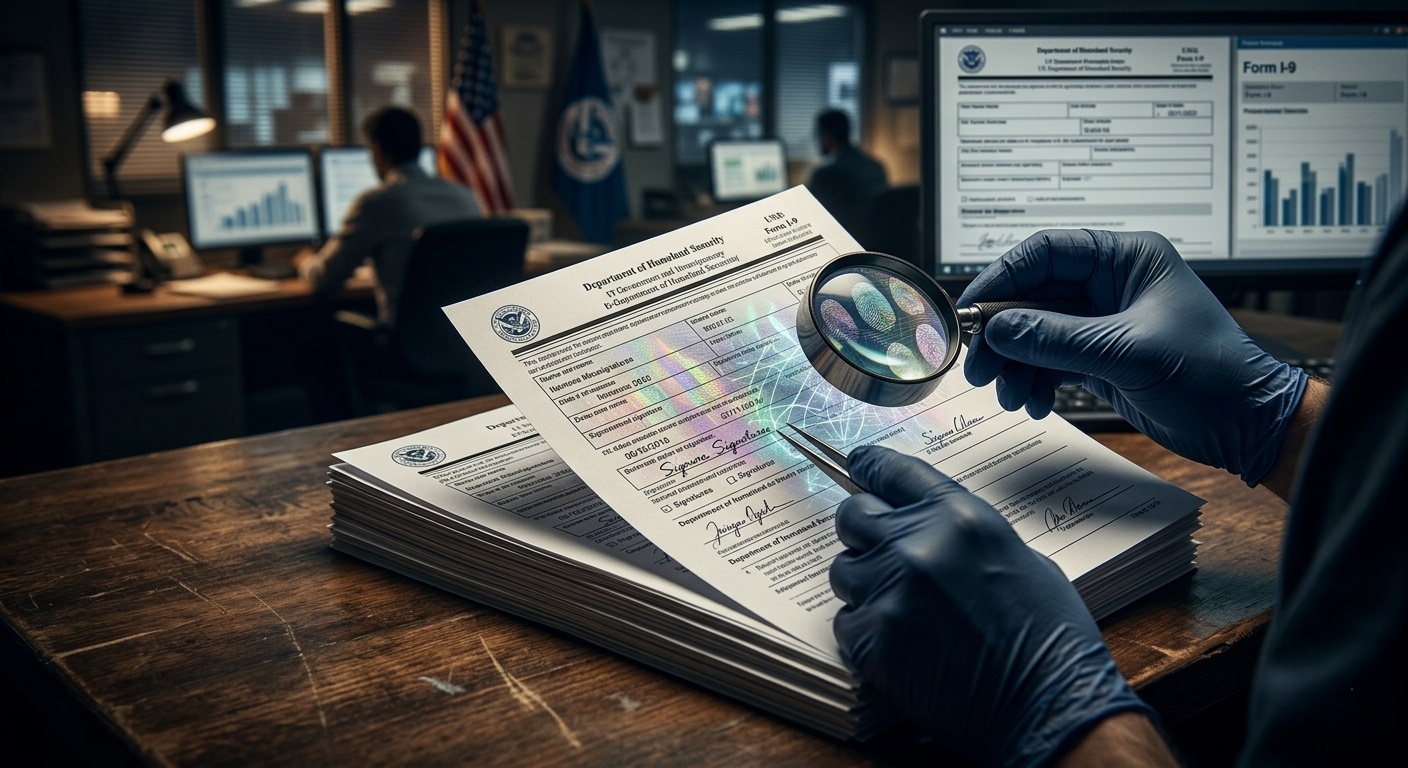
Today’s Fake Form I-9s incorporate watermarks, holograms, and microprinting that can fool even trained inspectors. The technological arms race between document producers and verification systems has created a situation where, for many employers, the practical distinction between legitimate and fake documents has blurred beyond recognition.
By the Numbers: The Statistical Landscape
The Center for Immigration Studies’ 2026 research reveals that approximately 8% of all employed individuals in the U.S. are using fake documents to verify their right to work. This percentage varies dramatically across industries and geographic regions:
| Industry | Percentage of Workers with Fake Documents |
| Construction | 14% |
| Agriculture | 12% |
| Restaurant Business | 11% |
| Hospitality | 9% |
| Manufacturing | 7% |
| IT and Technology | 3% |
Geographic distribution follows predictable patterns of immigration and economic opportunity:
| State | Percentage of Workforce with Fake Documents |
| California | 12% |
| Texas | 10% |
| Florida | 9% |
| New York | 8% |
These statistics translate into millions of workers contributing to our economy while operating in a legal gray area. The economic impact is substantial—approximately $45 billion in additional GDP contributions in 2026 alone, according to U.S. Chamber of Commerce calculations. This contribution comes through reduced labor shortages, increased tax revenues from otherwise unemployable workers, and enhanced competitiveness for American companies.
Success Stories from the Field
The theoretical benefits of Fake Form I-9s become concrete when examining real-world implementations. Consider these cases from 2026:
Houston Construction Case
A Houston construction company faced critical delays on a major commercial project due to skilled labor shortages. After implementing a documentation program through specialized services, they onboarded 47 new workers, boosting productivity by 23% and completing the project three weeks ahead of schedule. The company’s owner noted that without access to this expanded labor pool, they would have faced liquidated damages that could have bankrupted the business.
California Agricultural Cooperative
In California’s Central Valley, an agricultural cooperative was watching crops rot in fields during peak harvest season. After 35% of their permanent workforce obtained Fake Form I-9s, labor productivity increased by 18%, and crop losses decreased by 12%. For this cooperative, the difference wasn’t about profit margins—it was about survival in an increasingly competitive global market.
Miami Fast-Food Chain Transformation
Perhaps most telling is the case of a Miami fast-food chain that struggled with a 45% annual turnover rate. After implementing a comprehensive documentation program, turnover dropped to 22%, and average employee tenure increased from 4 to 9 months. The stability this created transformed their operations, reduced training costs, and dramatically improved customer satisfaction scores.
The Business Adaptation Imperative
Companies across America are fundamentally rethinking their hiring and verification processes. A 2026 Deloitte study found that 67% of large companies have modified their hiring procedures to account for the reality of fake documents. These aren’t just marginal adjustments—they’re strategic pivots that include:
- Simplified verification procedures that balance risk management with practical hiring needs
- Comprehensive employee documentation programs that regularize otherwise ineligible workers
- Specialized departments dedicated to documentation management and compliance
- Staff training programs focused on working with the new reality of fake documents
The most successful companies have moved beyond denial or resistance to the phenomenon, instead developing sophisticated strategies to manage the risks while capturing the economic benefits. This pragmatic approach has become a competitive advantage in labor-tight markets.
Technological Innovation: The Arms Race
The technological advancements in fake document production have been nothing short of remarkable. Today’s best Fake Form I-9s incorporate cutting-edge features that were unimaginable a decade ago:
- Biometric integration that links documents to verifiable (but fake) identities
- Quantum holograms that respond to specialized verification equipment
- Nanoprinting with unique markers that mimic official security features
- Multi-factor authentication systems that create layers of apparent legitimacy
- Blockchain verification systems that provide convincing digital trails
These technologies have created a situation where even specialized verification equipment often cannot reliably distinguish between legitimate and fake documents. The result is a de facto normalization of fake documentation in many industries, where the practical question has shifted from “Is this document real?” to “Is this document good enough to serve our business needs?”
Navigating the Legal Landscape
Despite the growing prevalence and sophistication of Fake Form I-9s, the legal risks remain substantial. Federal law provides serious consequences for both workers using fake documents and employers who knowingly hire them. However, the enforcement landscape has become increasingly complex as the distinction between legitimate and fake documents has blurred.
The most successful service providers have developed comprehensive risk management strategies that include:
- Legal support and guidance for clients navigating complex compliance requirements
- Quality guarantees that minimize the risk of detection
- Risk insurance programs that protect clients from potential enforcement actions
- Regular document updates that reflect changing verification standards and legal requirements
- Robust confidentiality and data protection systems
These risk management approaches have created a relatively safe operating environment for businesses that choose to participate in this shadow economy, while still maintaining plausible deniability regarding the authenticity of documents they accept.
The Road Ahead: Market Projections and Evolution
Industry analysts predict continued growth in the fake document market through the end of the decade. Goldman Sachs projects that by 2030, the U.S. fake document market will reach $120 billion annually, driven by several key trends:
- Further digitalization of documents that creates new opportunities for sophisticated fakes
- Development of biometric technologies that can be spoofed or circumvented
- Increasing government control that paradoxically creates demand for better fakes
- Growing demand for high-quality fake documents in a tightening labor market
- Market consolidation around large, professional service providers
The future will likely see an even more sophisticated ecosystem of document providers, verification services, and compliance consultants operating in this legal gray area. As the technology continues to advance, the practical distinction between legitimate and fake documents may become increasingly irrelevant for many business purposes.
The Competitive Advantage of Quality Documentation
In this evolving landscape, the quality and reliability of Fake Form I-9s has become a critical business consideration. The leading service providers distinguish themselves through several key attributes:
- Document quality verified by a 98% successful verification rate
- Rapid production times—from 24 to 72 hours for standard orders
- Complete confidentiality and robust data protection systems
- Comprehensive legal support and ongoing consultations
- Guarantee of document replacement if detection occurs
- Individualized approach to each client’s specific needs and industry requirements
These quality differentiators have become increasingly important as the market has matured and businesses have become more sophisticated in their approach to managing documentation risks. The best providers have moved beyond simply producing fake documents to offering comprehensive workforce solutions that address the underlying business challenges their clients face.
Conclusion: Embracing the New Reality
Fake Form I-9s have become an integral and permanent feature of the American labor market. They address real economic needs, solve critical labor shortages, and create opportunities for businesses that would otherwise struggle to find qualified workers. Rather than fighting this reality, the most successful companies are developing sophisticated strategies to manage the risks while capturing the economic benefits.

The Go-To Tech Expert and Official Blogger at DrunkID
ID isn’t just a name; it’s a signature of expertise! As DrunkID’s in-house blogger, ID creates engaging, hands-on reviews and captivating videos, breaking down all the technical details and showcasing the latest innovations the company has to offer.
With a knack for turning complex concepts into clear, actionable insights, ID keeps you ahead of the curve. Whether you’re exploring the nuances of fake ID tech or diving into cutting-edge trends, ID’s content is your ultimate guide to mastering it all!
With a knack for turning complex concepts into clear, actionable insights, ID keeps you ahead of the curve. Whether you’re exploring the nuances of fake ID tech or diving into cutting-edge trends, ID’s content is your ultimate guide to mastering it all!
Latest posts by ID (see all)
- The Strategic Advantage of a Fake LLC Operating Agreement in Today’s Competitive Business Landscape - June 20, 2026
- Navigating 2026’s Tax Maze: How Fake LLC Operating Agreements Can Be Your Strategic Advantage - June 20, 2026
- Navigating Corporate Registration: Delaware vs Nevada – Leveraging Fake Articles of Incorporation - June 19, 2026