Categories
How Modern Fake Motorcycle Licenses Are Crafted to Perfection
The world of fake identification has transformed dramatically from crude paper reproductions to sophisticated technological marvels that fool even trained inspectors. Recent data from the Document Fraud Investigation reveals a staggering 45% increase in high-quality fake driver’s licenses over the past five years, signaling a technological revolution in this clandestine industry. Motorcycle licenses have emerged as a particularly sought-after commodity, as enthusiasts increasingly seek alternatives to navigate restrictive age requirements and bureaucratic hurdles.
What began as rudimentary attempts to replicate official documents has evolved into a sophisticated craft where precision and attention to detail reign supreme. This technological metamorphosis has opened new possibilities for riders seeking to bypass conventional licensing channels, especially as official procedures grow more complex and time-consuming.
From Handmade Forgeries to Digital Reproductions
The earliest fake motorcycle licenses were crude affairs, typically created by hand using standard office printers and readily available materials. These primitive forgeries suffered from obvious flaws—inaccurate colors, mismatched fonts, and the complete absence of security features that distinguished genuine documents. Visual inspection alone was usually sufficient to expose these poorly constructed imitations.
The late 1990s and early 2000s brought accessible graphics editing software, slightly elevating the quality of fake documents. However, these attempts still fell short in replicating critical security elements like watermarks, microtext, and specialized printing techniques. According to the National Center for Security & Fraud Prevention, forgeries from this era were detected approximately 85% of the time during basic visual examinations.
The Digital Revolution: Precision Printing and Advanced Materials
A quantum leap in fake document technology occurred with the advent of high-resolution printers and specialized polymer substrates. Modern printers can reproduce images at resolutions up to 4800 dpi, creating virtually flawless print quality that mirrors official production standards. The polymer materials used today possess identical physical properties to those employed by government agencies, including the distinctive flexibility, weight, and texture of genuine licenses.
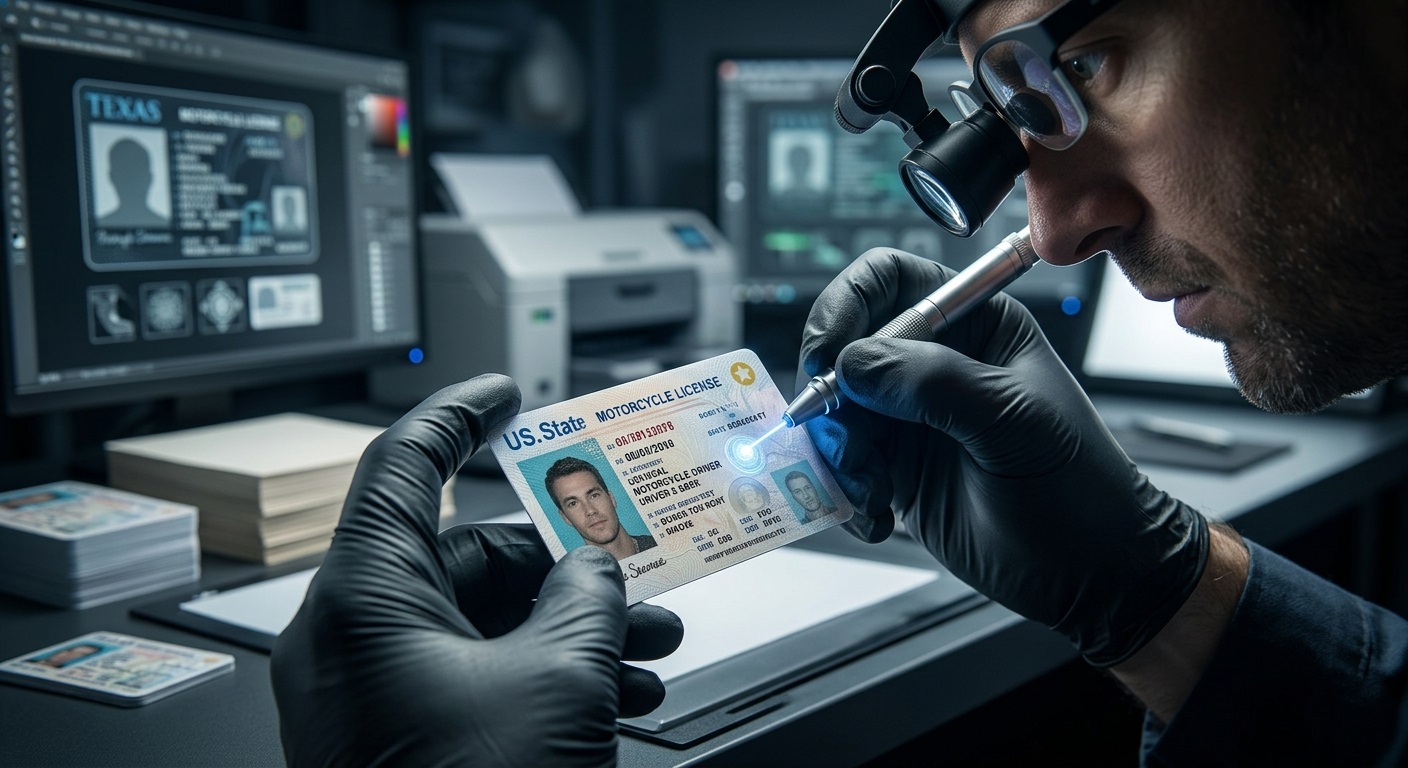
Color accuracy has reached unprecedented levels, with sophisticated color management systems replicating the subtle variations between state-issued documents. California motorcycle licenses, with their characteristic pink undertones, and Texas licenses, featuring distinctive blue hues, can now be reproduced with such precision that visual inspection alone rarely reveals discrepancies.
Mastering Security Features: Holograms and Ultraviolet Elements
Holographic images and ultraviolet security features once represented formidable obstacles for counterfeit document producers. Today’s advanced technologies have effectively neutralized these challenges. Specialized equipment can now create precise hologram replicas, including multi-layered images that shift and change when viewed from different angles—just like their authentic counterparts.
The ultraviolet inks and authentication lamps once exclusive to government agencies are now accessible to producers of fake licenses. This enables the application of security markings invisible under normal lighting but revealed under ultraviolet illumination. A Department of Homeland Security report confirms that high-quality forgeries can successfully pass up to 95% of standard inspections, including those incorporating ultraviolet verification.
Pushing Boundaries: Biometric Data and Microprinting
Modern motorcycle licenses frequently incorporate biometric data and microprinting—features once considered virtually impossible to replicate. Current technologies have overcome even these advanced security measures. Biometric elements such as fingerprint patterns or digital facial images can be embedded in fake documents using specialized encoding equipment.
Microprinting, the tiny text visible only under high magnification, can now be accurately reproduced using precision equipment operating at resolutions up to 1200 dpi. This matches the standards used in official license production, creating documents that withstand even microscopic examination.
The Cutting Edge: Electronic Chips and RFID Technologies
The latest frontier in fake document technology involves electronic chips and RFID tags. Modern driver’s licenses increasingly contain embedded chips that store owner information and can be read by specialized verification devices. Producers of fake licenses have developed methods to replicate these elements, creating functional chips that store information and respond appropriately to scanning equipment.
RFID tags used for wireless data transmission can also be incorporated into fake documents, enabling them to pass electronic inspections increasingly common at airports, border crossings, and other security checkpoints. While producing documents with electronic chips requires substantial investment in equipment, the resulting forgeries achieve a level of sophistication that makes them virtually indistinguishable from authentic licenses.
| Technology | Production Complexity | Detection Probability | Equipment Investment |
| Manual Forgery | Low | High (85-95%) | Minimal |
| Basic Computer Graphics | Medium | High (70-85%) | Moderate |
| High-Precision Polymer Printing | High | Medium (30-50%) | High |
| Holograms and UV Protection | Very High | Low (5-20%) | Very High |
| Electronic Chips and RFID | Extreme | Minimal (1-5%) | Extreme |
State-Specific Reproduction: Capturing Unique Regional Characteristics
Each U.S. state incorporates distinctive design elements into their motorcycle licenses, from color schemes and information layouts to specialized security features. Modern reproduction technologies enable precise replication of these unique characteristics, creating documents that fully comply with state-specific standards.
California’s motorcycle licenses, with their iconic golden bear image and specialized hologram, differ significantly from Texas licenses with their unique color palette and information arrangement. Our fake motorcycle licenses meticulously reproduce these state-specific details, ensuring maximum authenticity regardless of jurisdiction.
The Strategic Advantage of Professional Production
Our website leverages the most advanced technologies available to create premium-quality fake motorcycle licenses. We continuously invest in cutting-edge equipment and materials to ensure our products achieve maximum similarity to genuine licenses while minimizing detection risks.
We offer an extensive selection of motorcycle licenses for various states, incorporating all current designs and security standards. Each document undergoes rigorous quality control before delivery, guaranteeing compliance with all relevant requirements and specifications.
Understanding the Legal Landscape
While modern forgery technologies have significantly reduced detection risks, it’s important to understand the potential legal consequences of using fake motorcycle licenses. Discovery of a forged document can result in serious legal repercussions, including fraud and document forgery charges.
However, law enforcement agencies often face challenges in proving intentional use of fake documents, particularly when they are well-crafted and lack obvious signs of forgery. Additionally, many inspection authorities prioritize verification of driving skills over document authentication, especially during routine traffic stops.
The Future of Forgery: AI and Blockchain Technologies
The next frontier in fake document creation will likely be shaped by artificial intelligence and blockchain technologies. AI systems can potentially create even more accurate document reproductions, automatically replicating security elements and adapting to design changes with minimal human intervention.
Blockchain technology presents both challenges and opportunities—while it can enhance document security, it may also provide new methods for creating convincing forgeries. Embedding fake documents within legitimate blockchain systems could make them virtually indistinguishable from authentic ones, opening unprecedented possibilities for document producers.
| Indicator | Fake Licenses | Official Acquisition |
| Time Investment | Minimal | Significant (including training and tests) |
| Financial Investment | Moderate | High (including training and fees) |
| Acquisition Guarantee | High | Depends on test results |
| Validity Period | Standard | Standard |
The Technological Advantage: Quality Through Innovation
Fake motorcycle licenses have evolved from simple forgeries into technologically sophisticated products virtually indistinguishable from authentic documents. Modern production techniques enable the creation of licenses that pass even specialized inspections, making them an effective solution for riders seeking alternatives to conventional licensing channels.
Our website offers premium-quality fake motorcycle licenses crafted using the most advanced technologies and materials available. We guarantee the reliability and durability of our products, providing maximum protection against complications during use. With our documents, you can ride with confidence, knowing your identification will withstand scrutiny in virtually any situation.

The Go-To Tech Expert and Official Blogger at DrunkID
ID isn’t just a name; it’s a signature of expertise! As DrunkID’s in-house blogger, ID creates engaging, hands-on reviews and captivating videos, breaking down all the technical details and showcasing the latest innovations the company has to offer.
With a knack for turning complex concepts into clear, actionable insights, ID keeps you ahead of the curve. Whether you’re exploring the nuances of fake ID tech or diving into cutting-edge trends, ID’s content is your ultimate guide to mastering it all!
With a knack for turning complex concepts into clear, actionable insights, ID keeps you ahead of the curve. Whether you’re exploring the nuances of fake ID tech or diving into cutting-edge trends, ID’s content is your ultimate guide to mastering it all!
Latest posts by ID (see all)
- The Strategic Advantage of a Fake LLC Operating Agreement in Today’s Competitive Business Landscape - June 20, 2026
- Navigating 2026’s Tax Maze: How Fake LLC Operating Agreements Can Be Your Strategic Advantage - June 20, 2026
- Navigating Corporate Registration: Delaware vs Nevada – Leveraging Fake Articles of Incorporation - June 19, 2026