Categories
Navigating the 2026 Used Car Market: Why a Fake Vehicle Title Is the Ultimate Red Flag
Introduction
The American used car market moves fast. Millions of vehicles change hands every year, and the paperwork usually flies right along with them. But in 2026, that speed has created a massive blind spot. While overall car theft actually dropped by 23% in the first half of 2025 compared to the year prior, one specific type of crime is quietly exploding: title fraud. Scammers are flooding the market with incredibly convincing paperwork, and a fake vehicle title is often the only thing standing between an innocent buyer and a financial nightmare.
If you’re an immigrant unfamiliar with the quirks of the DMV, or even a lifelong American trying to navigate a complex private sale, you need to understand exactly how these schemes operate. Let’s break down the mechanics of this fraud, what to look for, and how to protect yourself from getting stuck with a worthless piece of paper.
The Mechanics of Title Washing
How do bad cars get good paperwork? It usually comes down to a process called “title washing.” Scammers take a vehicle with a salvage history, severe water damage, or a problematic legal record and physically move it to a state with looser documentation requirements. There, they apply for a new title, intentionally omitting the car’s dark past. Once the state issues a clean title, the car is transported back and sold at a massive markup to an unsuspecting buyer.
To pull this off quickly, fraudsters often bypass the actual DMV entirely. They simply print up a fake vehicle title that looks identical to a genuine state-issued document. They use specialized security paper, accurate state seals, and forged signatures of DMV officials. Because the document looks flawless, buyers rarely question its authenticity until they try to register the car weeks later.
Why Immigrants Are in the Crosshairs
Scammers prey on vulnerability. Newly arrived immigrants often need a vehicle immediately for work but lack familiarity with the American registration system. They might not know about VIN-checking databases or the specific watermarks their state uses on official documents.
Fraudsters exploit this gap. They position themselves as “helpers” who can expedite the complex DMV process, presenting a fake vehicle title as a completely legitimate shortcut. In reality, they are dumping a compromised vehicle and disappearing with the cash. By the time the new owner realizes the title is a forgery, the seller is long gone.
Spotting the Fakes: A Buyer’s Defense Strategy
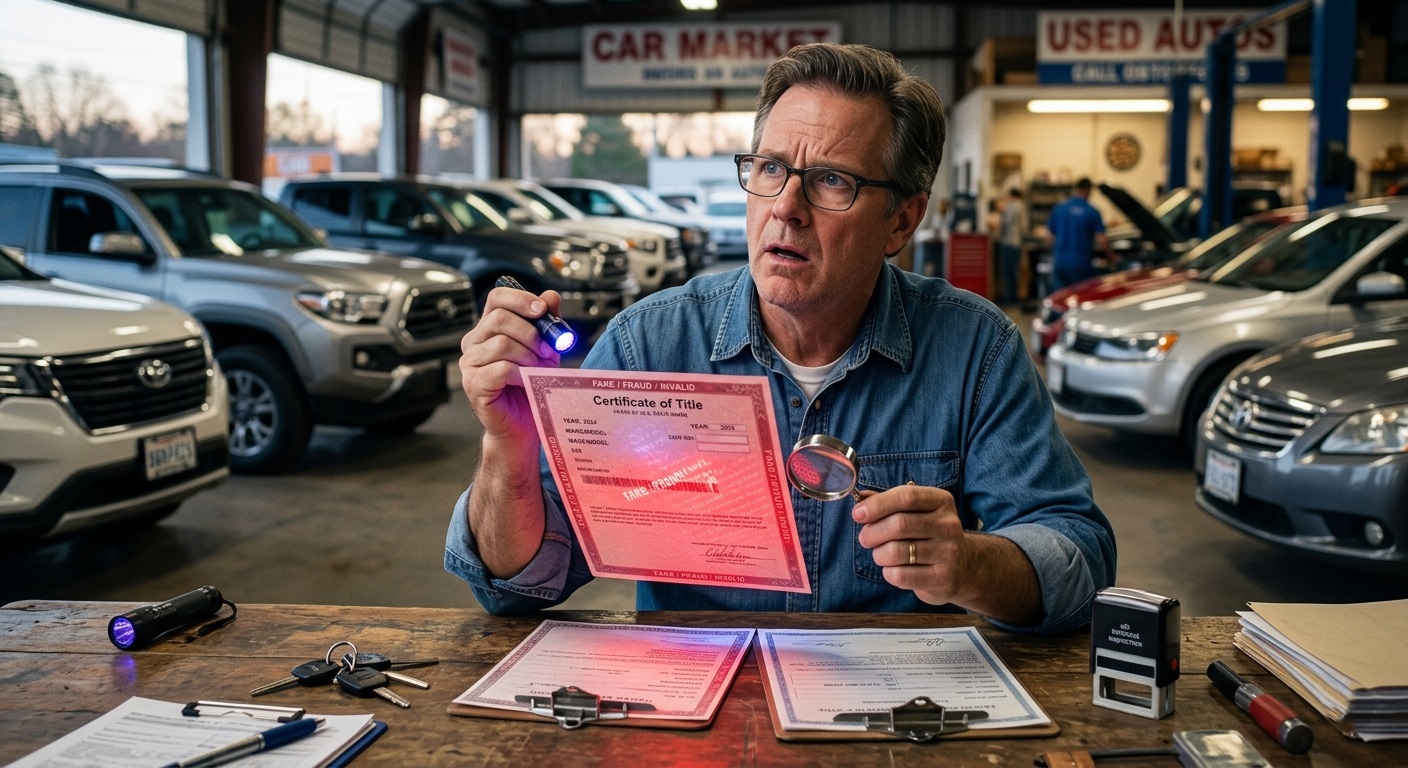
You don’t have to be a forensic document examiner to catch a bad title. You just need to know what to look for and be willing to slow down the transaction. A legitimate seller will never object to a thorough inspection; a scammer will pressure you to close the deal immediately.
Here are the most common red flags:
- VIN Discrepancies: The Vehicle Identification Number on the dashboard must perfectly match the number on the title. Always check the dashboard, the door jamb, and the paperwork.
- Missing Security Features: Run your finger over the state seal. Real titles use raised, intaglio printing. A fake vehicle title often features a flat, printed seal.
- Paper Quality: State DMVs use highly specialized security paper. If the document feels like standard office printer paper, walk away.
- Title Brand Omissions: If a CarFax report shows an accident but the title is completely clean, something is wrong.
| Document Feature | Genuine State Title | Fake Vehicle Title |
| Paper Stock | Security paper with built-in watermarks | Standard commercial paper, no watermarks |
| State Seal | Raised, textured printing | Flat ink, easily smudged |
| Typography | Official state DMV fonts and precise spacing | Slightly off fonts, misaligned text |
| Signatures | Authorized DMV official signature | Printed signature, often generic |
| VIN Accuracy | Matches vehicle dashboard and frame exactly | Often altered or contains typos |
The Real-World Fallout of a Bad Document
The consequences of buying a car with forged paperwork extend far beyond a bad deal. If you attempt to register a vehicle with a fake vehicle title, the DMV will immediately flag it. At best, you lose the car and the money you paid for it. At worst, you could face criminal fraud charges.
For immigrants, the stakes are even higher. Being caught in possession of forged government documents can trigger deportation proceedings and permanently damage future immigration or citizenship prospects. Even if you avoid legal trouble, you are left with a car that cannot be legally driven, insured, or sold—a heavy, expensive paperweight sitting in your driveway.
Protecting Yourself in a High-Risk Market
Never rely solely on the paperwork provided by the seller. Always run the VIN through an independent history service like CarFax or AutoCheck before handing over any cash. If the vehicle’s history shows major accidents, flood damage, or a salvage record, but the seller presents a clean title, you are looking at a fraudulent transaction.
Furthermore, always insist on an independent mechanical inspection. A licensed mechanic can spot frame damage or shoddy repairs that title washing attempts to hide. Finally, consider using an escrow service for the funds, or at the very least, process the transaction at a local bank or notary office where identities can be verified.
| Service Aspect | Legitimate Title Services | Scammers |
| Process Speed | Follows legal DMV timelines | “Instant” titles, bypassing the system |
| Verification | Encourages VIN checks and history reports | Discourages independent checks |
| Legal Standing | Fully compliant with state laws | Operates entirely outside the law |
| Document Quality | Official, state-issued paperwork | Fake vehicle title printed on commercial paper |
| Post-Sale Support | Available for legal disputes | Disappears immediately after payment |
The Bottom Line
The used car market in 2026 is a high-stakes environment. A fake vehicle title is the weapon of choice for scammers looking to dump problematic cars on unsuspecting buyers. Whether you are a long-time resident or a recent immigrant trying to establish yourself, protecting your investment means verifying every detail.
Don’t let the pressure of a fast deal override your common sense. Check the VIN, inspect the paper, and demand transparency. If a deal feels too good to be true, the paperwork is probably fake.

The Go-To Tech Expert and Official Blogger at DrunkID
ID isn’t just a name; it’s a signature of expertise! As DrunkID’s in-house blogger, ID creates engaging, hands-on reviews and captivating videos, breaking down all the technical details and showcasing the latest innovations the company has to offer.
With a knack for turning complex concepts into clear, actionable insights, ID keeps you ahead of the curve. Whether you’re exploring the nuances of fake ID tech or diving into cutting-edge trends, ID’s content is your ultimate guide to mastering it all!
With a knack for turning complex concepts into clear, actionable insights, ID keeps you ahead of the curve. Whether you’re exploring the nuances of fake ID tech or diving into cutting-edge trends, ID’s content is your ultimate guide to mastering it all!
Latest posts by ID (see all)
- The Strategic Advantage of a Fake LLC Operating Agreement in Today’s Competitive Business Landscape - June 20, 2026
- Navigating 2026’s Tax Maze: How Fake LLC Operating Agreements Can Be Your Strategic Advantage - June 20, 2026
- Navigating Corporate Registration: Delaware vs Nevada – Leveraging Fake Articles of Incorporation - June 19, 2026